
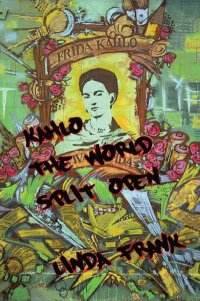
KAHLO: THE WORLD SPLIT OPEN
Linda Frank’s poetry connects the contemporary feminine voice to artistic perceptions of Kahlo. Kahlo: The World Split Open engages the reader with the story behind the artist’s paintings, creating a fictional observation of Kahlo’s life through the eyes of the painter. Frank’s poetry creates a connection where “the ekphrastic poet typically stands in a middle position between the object described or addressed and a listening subject” (Mitchell 164) and lets the reader “see” (Mitchell 164). Frank’s ekphrasis is “stationed between two ‘othernesses,’” (Mitchell 164) and the “two forms of (apparently) impossible translation and exchange” (Mitchell 164). The poetry combines Kahlo’s art with a contemporary poetic reflection to create a new, more richly layered picture.
Works Cited:
Mitchell, W. J. T. Picture Theory. Chicago: Chicago UP, 1994.
TH: I guess the first question I want to know, and I’m sure many others will too, why Kahlo? What was it about her that sparked your imagination?
LF: After my first book was published, I was looking for a project. I wanted to write a series of poems in the form of letters and I’d been very interested in Kathe Kollwitz, but when I looked at Kollwitz’s work again and read a little about her I found myself quite uninspired. I thought about Georgia O’Keefe for awhile. But then one day I came across an article that mentioned that the Mexican painter Frida Kahlo had had an affair with the Russian revolutionary Leon Trotsky. And I was really surprised because I’d read several histories of the Russian revolution and many biographies, including the three volume biography of Trotsky by Isaac Deutscher and never remembered hearing more than that he’d hung out with Diego Rivera and had been assassinated in Mexico. Sure enough, when I looked it up – barely a mention of Kahlo. So, I originally just wanted to write a poem about how women have been erased from history. When I looked Kahlo up, I got all entranced with her work and her life, the parallels between the era she came of age in in Mexico, with the era I came of age in in Quebec (Mexican Revolution/Quiet Revolution) – and started to write poems about her – or my poetic idea of her – who she might have been and I didn’t get around to the Trotsky material till I’d written about 20 others first.
TH: What was your process for writing the book? For example did you stare at the paintings for hours, read everything in sight, or did you just think nothing of the sort, and create a life you thought she had lead?
LF: The most embarrassing thing is that I did not go to Mexico and see her house or her work. I did manage to see some of her paintings in the show that travelled across Canada that included work by O’Keefe and Emily Carr. But that was before I really started the book. And even more embarrassing, I didn’t read her biography – I still haven’t, I just dipped in to find facts or names or places. I did read her letters – she wrote a lot of letters – and I did stare at her painting in reproduction. I did research Mexico and I did look at photos of her house. Mostly though I created a life I thought she would lead, and used her paintings as clues for me to follow. I thought about her as I thought about myself, coming “of age” at a time and in a place where the left was on the rise and social convention was being challenged.
TH: What did the experience of writing about art and painting do for your writing? Did it change the way you write, or did you gain a new appreciation for art?
LF: Hmmm. Well I knew very little about art then and I know very little now. So, I am not sure that part of it changed my experience in any way. But it did change the way I write, and I was worried about that a lot. I am not a narrative writer. I use symbolism and image to tell my “stories”, but this book forced me to write more on the narrative axis. I found that I chafed at writing in a narrative voice, that I didn’t enjoy it much and that it doesn’t come naturally to me. I worried a lot about moving away from my voice. But in the end, I think I overcame those worries – I hope!
TH: I know myself, in writing the Egon Schiele manuscript, I purposely tried to avoid reading any poetry books on art (though I was aware at the time of several other books already in print that deal with Schiele, I didn’t want to read them right away), but because everyone’s process is so different, I’m wondering if you read any ekphrastic poetry before you began your project?
LF: Well yes. I read Kate Braid’s book and loved it a lot and because of her book I had the idea of writing about an artist – even thought of inventing a relationship between Kollwitz and O’Keefe and writing a series of letters. I read John Barton’s book on Emily Carr as well. While I was writing about Kahlo I read three books of poetry on her (so different from mine!) and I think two or three novels. I didn’t want to avoid them because I knew my take would be very different and I didn’t feel hampered by fact or telling the truth. I made it up. I mean there are objective truths in there, but the facts are messed around with for sure. Any Kahlo scholar would have my head! Thank God it’s poetry!
TH: Who do you read consistently and which writers do you admire in poetry right now?
LF: Who do I read consistently? Well I will buy any book by Adrienne Rich or Dionne Brand. Any book by Don Domanski. Patrick Lane or Russell Thornton. I find myself going back to them over and over. I have a huge admiration for Don McKay. Lately I’ve fallen for Carl Phillips and Bob Hicok. But I read pretty widely. And I am sure I am leaving someone really important to me out.
TH: I think most of us get a start writing poetry because someone (usually another writer) motivates us to do so; we continue to write because of their support, believing in us, and that what we’re doing is worthwhile. How did you begin to write poetry? Did you have any mentors that helped you or that continue to help you with your writing?
LF: Well to tell you the truth, I began to write poetry in grade two. I wrote and wrote rhyming verse and my father has kept it and for my birthday one year not too long ago, presented me with a scrapbook of it. It had real rhyme and meter. You can see I was in love with words and music even that young. I have always written poetry, never actually thinking of myself as a writer or that I would ever publish.
The first poem I ever fell in love with I found in a grade 5 reader. It was “Patterns” by Amy Lowell. And when I was in 8th grade (first year of high school in Quebec) I went to the local public library and decided to read all the poetry there, beginning with the letter A. When I got to “C” I hit Leonard Cohen’s “Spice Box of the Earth” and I just couldn’t believe someone wrote like this! I didn’t understand it all but I was determined to – and I read and re-read that book and Let Us Compare Mythologies – until I might have had them memorized. But I have to say that Cohen and Bob Dylan and Phil Ochs probably were my “mentors”. But no one in “real life” helped me really back then.
TH: Do you have plans to write anything else? I think most people assume all writers secretly desire to write a bestselling novel, but how about you, do you dream of writing a novel someday or are you content with poetry?
LF: I am very close to finishing a third poetry manuscript called Insomnie Blues. And I struggle with a novel but lately I’ve decided to take most of the material I was covering in the “novel” and turn it into my 4th manuscript called Tribe – it will either be a series of prose poems or one long prose poem. Maybe that’s a step toward being able to write fiction? To get a line physically across a whole page?
TH: Can you share a little of your writing process with us? Do you streak naked around the house for an hour, slapping your skin with air to beat the words out of you?
LF: I wish that would work. If it would work I would do it! I am a very, very slow, painstakingly slow, writer. Insomnie Blues however, shot out of me in a year. But that’s very unusual. I usually begin with one line that comes to me because something I read triggered it. I write in longhand, with a fountain pen. I write the line and it slowly turns into a stanza. Then I write it over and over again till the next stanza begins. And I write it all over and over again by hand till I get almost to then end. Where I get stuck. It’s then I transfer it to computer and wait and hope the end will come.
TH: Are you planning a tour to promote the book? Will we see you out west?
LF: I’d love to be able to come out west this spring to promote the book and I am working on setting up a reading tour with another poet and friend of mine so that I have someone to fly with (I HATE flying). Invite me (us) and I’ll come!!!




 manageable imaginations