A Short Review

In film noir style, Brick delivers a sharp, sometimes darkly comical, and often witty modern version of the detective story. The plot swiftly lures the audience through quick-cuts, flashbacks, pointed angles and a sturdy lead character in the loner Brendan Frye (Joe Gordon-Levitt—3rd Rock From the Sun’s Tommy). Brick is an intensely intertwined tale that pulls the audience easily along, even stopping occasionally to have some pun/fun along the way.

Like those lead males that came before him, Gordon-Levitt delivers the goods to the audience. Many of Brendan’s lines are reminiscent of Sam Spade (Bogart fashioned), but sometimes the delivery of the lines by Gordon-Levitt is incoherent. The one-liners, while important to a mirroring of style, aren’t really that important to the tale, although the humour and wit found in them is worth hearing. The movie’s modern cinematic touches, while often comedic in the film noir style—The Pin’s mother proved great comedic relief—appear regenerated in the modern film by their lack of modernization. My teenager, who tagged along for the show, thought the teenage world in the film rather unrealistic; there were no emails and computers, very few cell phones, and as she was quick to point out after the show (maybe too much so), no one went to classes at school.

Some of the elements that made a classic noir film are missing, such as the black and white shadowy images, and a multitude of gloomy night scenes, while others are noticeably present and effective, not so much in the expressionist manner, but effective at representing the eye-level view of Brendan. I enjoyed the film, and would really love a chance to see it again to gather in more of the cinematic themes/metaphor that ran throughout the film—such as the sound of running water, the sun, the shoes.

Tonight I’m watching another film, hopefully as interesting: A Good Woman (it was out on video afterall).

Last night

…I watched tv, for something completely different. I don’t watch much tv, but I was lazy and gave in to it. The most fascinating thing I saw last night was a tv program on the amazing musical ability of a woman with Williams Syndrome. Gloria Lenhoff has perfect pitch, sings in a multitude of languages, and remembers each and every song, but has trouble with basic math.

It must have left an impression on me, as my dreams last night were feral; this morning I’m still rather fuzzy. I’m drinking my coffee mulling over the meaning of two dreams, the two that I best remember from last night–or early this morning–and wondering, because both dreams dealt with the physical body, if what I was watching crept in to the realm of dreaming, or if I should really pay attention to my physical body, my life, and my surroundings. Hmmmm.

So

…we’re going to see the movie Brick on Saturday night at 9 pm at the RPL, if anyone is interested in tagging along, let me know.

A quote:

I thought once that poems were like words inscribed in rock or caught in amber. I thought in these terms so long, so fervently, with such investment in images of preservation and fixity, that the inaccuracies of the metaphor as description of my own experience did not occur to me until very recently. What is left out of these images is the idea of contact, and contact, of the most intimate sort, is what poetry can accomplish. Poems do not endure as objects but as presences. When you read anything worth remembering, you liberate a human voice; you release into the world again a companion spirit.

I read poems to hear that voice. And I write to speak to those I have heard.

–Louise Glück, Proofs and Theories

Maybe

… poetry can be edited, maybe it can even be enhanced at an initial stage, but once a poem is printed, it’s printed. What I’m wondering most about lately are the impressions an author/artist leaves on an audience and what makes an audience object to an artist’s work.

Once a is poem written down and published, it’s published–or so it seems to me. I really don’t understand what joy some people get out of rehashing an already finished product. I don’t understand this method of critique. Sure, I can change a poem to suit my own sensibility, but where would that get the poem? What does that do for an already published piece? Maybe a workshop poem could stand some treatment, but published?

Although, I suppose from any reader’s standpoint, perhaps the reader could’ve done better–they could’ve changed the poem to suit the reader. Don’t we all see ourselves as writing things better? Personally, I think that writing better entails writing poems different, and writing different poems better. It entails taking what we read, learning from what is before us, and interpreting, hopefully improving on what we read and learning from what we read, thus enhancing a product that we can place before the reader. Or not.

Here’s

…Annette Bower, after finishing her novel, caught languishing in her bug (which is much more friendly than a blood-sucking mosquito any day–and way cuter). Having recently returned from St. Peter’s Abbey, where she completed the novel, Annette is set to globetrot through North America promoting blue bugs, novels, romance, and Saskatchewan writing.

Here’s me a small time poet thinking about making a run for it in the bug (I’m hampered from a smooth getaway by traffic and someone with a camera).

Annette’s visit to St. Pete’s was productive in other ways, and the Muenster consignment store and the Humboldt Goodwill store coughed up two sets of my favourite luncheon plate/cup sets for next to nothing. Both sets were gifted to me by Annette. Thanks Annette. To see them (and Annette) you’ll have to visit.

I suppose

…most people would say that age is a factor in allergies. I, preferring to be ageless, think there seems to be more allergens around (what with all the hybrid-breeding happening–who knows what they’re creating in pollen). Whatever the cause, I’ve had a headache for the past two weeks straight and this weekend I’ve lived on heavy doses of coffee and ibuprofen. I’m not able to take an antihistamine so I must rely on what is available. I thought maybe I should try something more herbal, more natural (what is natural these days?) or homeopathic, so I looked up some remedies on the net. This remedy seems a little easier to carry out, but this one confused me, what kind of match do they want, two thumbs? My father tried the match trick once to remove a tick from the nape of my hairline (although luckily for me, I had a short curly fro when I was young)–he lit the match, thought he’d put the match out, and then put the match to the tick (this was supposed to cause the tick to back out of the fleshy burrow of my head without any fuss); however, the match was still lit and whoosh… well, you get the picture. I suppose that says something about home remedies–or not.

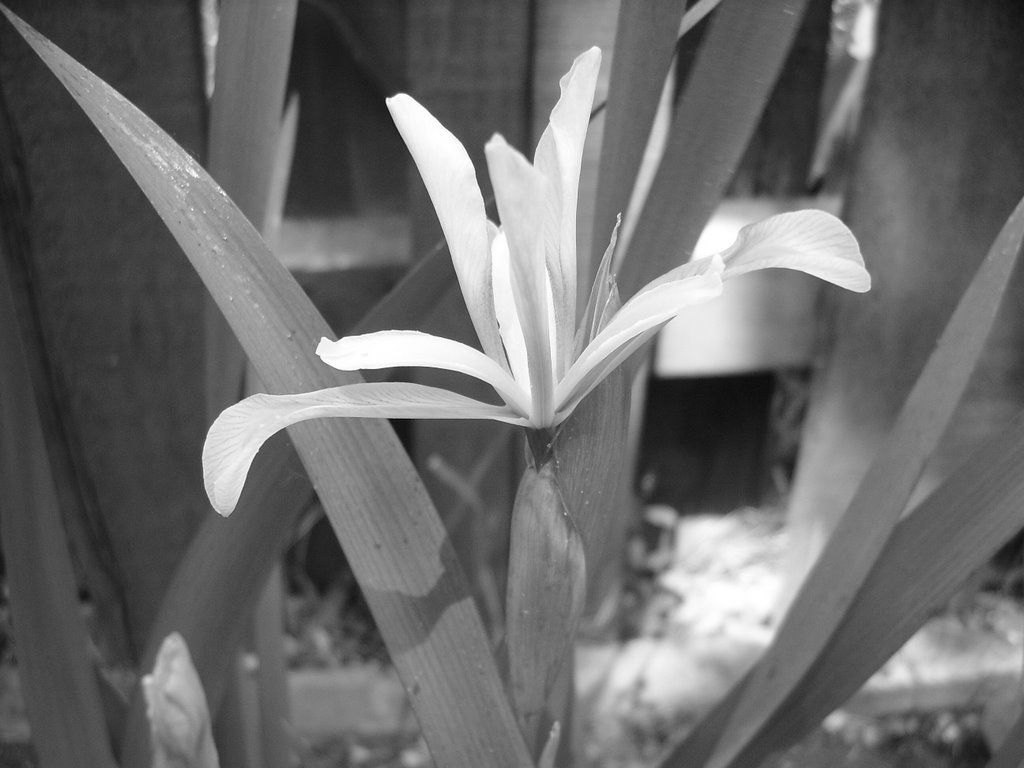
The black and white flower is the Siberian iris. It blooms in slim 2 in blossoms in late spring. This one I salvaged when I moved around 10 years ago, and its really only begun to bloom again in the past few years, although there had always been foliage. Now it really seems to be productive.

The top flower is a painted daisy. On May Day I posted some small poems about the painted daisies. Unfortunately, May Day is now over; it was a great deal of stimulating reading, writing, and responding, all of which I enjoyed immensely and thanks to everyone who took part, and to Ariel and Polly for organizing the blog. But back to the flowers, I adore the colour of my painted daisies–I believe they are of the Robinson variety (I’ve always called them the Mrs. Robinson); I also believe they come in different shades (in Watrous the diner had artificial blue). The mosquito popluation has increased dramatically in the past few days–rain or a storm everyday, while great for the newly sprung garden (although something strange has happened to the watermelon and it is now flopping its leaves in disgust) and annuals and perennials, is also the best thing for the breeding of bugs. I’m lucky in that they don’t really like the taste of me, but even so, I’ve been bit too much in past few hours so this is my excuse for parking myself in front of the computer and pretending I’m a writer.

Writers on artists

…is something I’ve been overthinking this past month. Why? Can’t really say; artists are no more or less elusive (allusive?) than any other inspiration, whether it be flowers, or seasons, or people, or poems about people smelling the flowers, or maybe poems about people painting pictures that look like flowers, or poems painted that look like people are what people need to write. Maybe we’re all simply “journey agents” as this reviewer says about Ashbery. I like to think it’s all relevant to the process of whatever it is we’re contemplating about life at that particular time. Or not.