
…with the sound of buzzing. Horseflies, deerflies, flies, wasps, bees, and mosquitoes. Yesterday I was bit by something that left a small stinger. There are motorboats that buzz the lake. Airplanes in the sky. These sounds circle me. And in the evening at Emma Lake we stop to listen: to grebes, a muskrat, some beavers, and other artist/writers as we gather around the fire. Sometimes we are quiet, and gaze at the sun, setting in the distance. 
Emma Lake
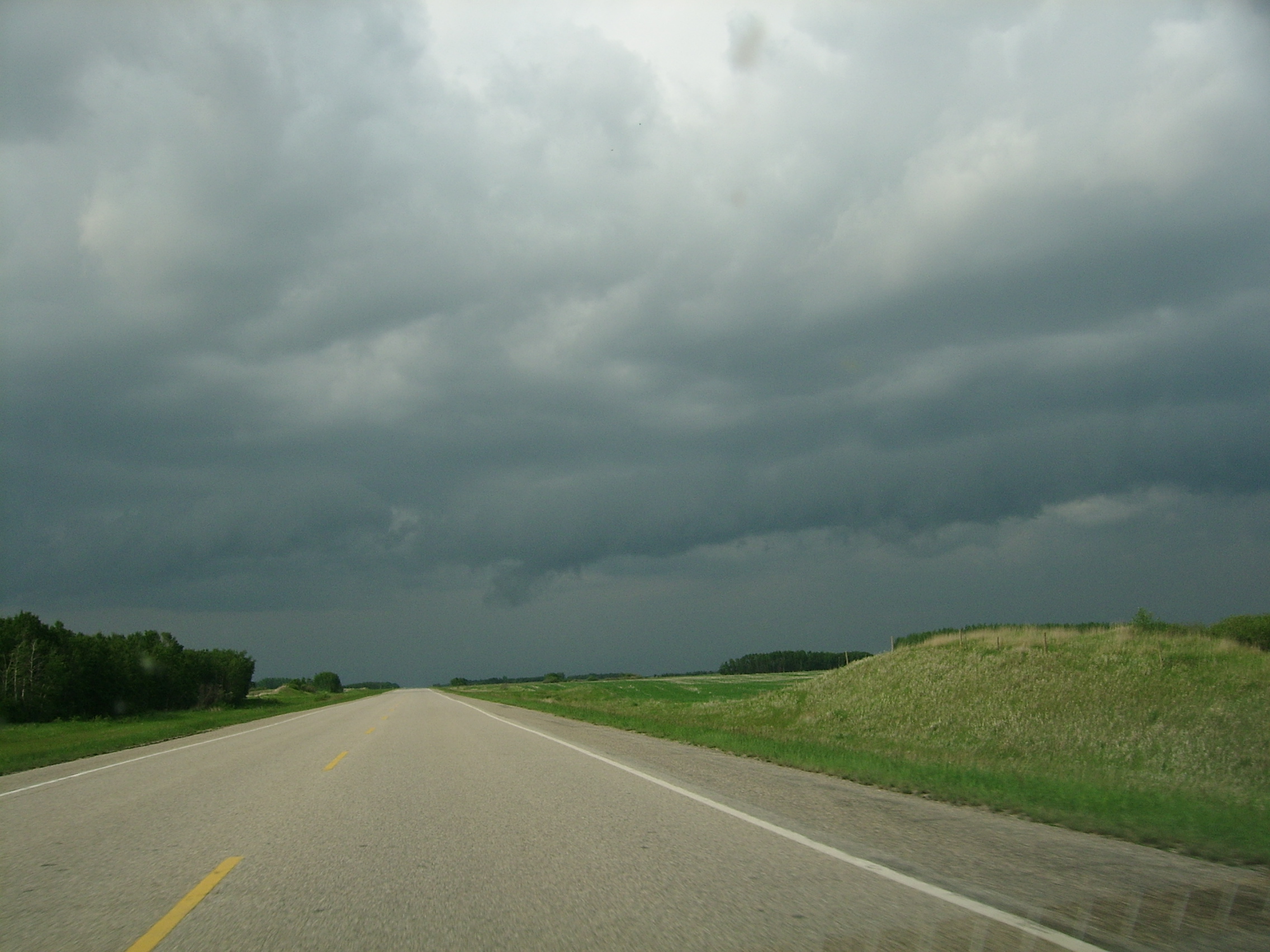

The road up was rather interesting, but nothing really came of this storm.
I like the totems.
More shots of the lake later. I’m going to try for the sunset.

Where writers go to play. Or maybe our minds might follow the bouncing ball. Strange sign in the middle of nowhere.

The sunset was hindered by clouds tonight, so hopefully another night will show better; however, I liked the sky, and the reflection on the water in this shot. I have a view of the lake through the trees from my cabin.
THINGS THAT MAKE ME GO
…hmmmm. Last night I had the pleasure of attending the last Unscripted session, Straight From the (Rural) Hip hosted by the Dunlop Gallery at the Regina Public Library. The conversation included Heather Benning, Heather Cline, Joe Fafard, Angus Ferguson, and Terry O’Flanagan. It was interesting to listen to the experience and role of the artist in the rural setting, and compare this to my rant about the prairie poet.
So, here I sit in the city, with my laptop, headphones on, music blaring (tonight it’s Leela James as I’m pretty much finished with the Damien Rice for now) thinking about how the conversation was structured around the differences in perception of rural and urban artists, and the consequences, problems, benefits, and reasons in their isolation and art. Really, not much different than the prairie poet. The need to create a sense of community about our art is strong, but (and I forget exactly who said this) is there a point where we create a community around us simply to talk about our art, rather than focusing on getting our art out, or even creating more art, for the public? Of course, what this reminds me of is Ezra Pound, and his notion of creating a sense of community, and how this has trickled down (into/throughout) the past hundred years to our own community, and the outcroppings of creative writing programs, and their immediate sense of community. And where am I going with this, you’re asking yourself right now, and I’m not really sure. The word nostalgia came up often in the conversation. Are we nostalgic to want to create our art from a space we know, rather than one we don’t, and what does this say about us as creators? I don’t know that there were any hard answers, but I wanted to know more about what makes the prairie gothic work, what makes it exist, what is it? Why are these definitions so hard to pin down? Much like the term “prairie poet” afflicts us just for being here, does the label “rural artist” hold the same weight in the world? I’m still thinking on these things, with no real answers other than the fact that we are all aware of our roots, where we come from, and some of us like to keep digging at the ground around them, just to make sure the roots are still there.
I MISSED
…all four crab apple trees in full bloom this spring, which is a bit of a disappointment, but I did manage to arrive home to the purple swing of these gems! I like these way better than those strange blossoms called “hops”, heh.

ANYONE
 …can take a photo of a mountain, but a dead tree requires a poet along the Bow river as the clouds begin to rise from hugging the rock, a poet clad in thongs and a skirt as she climbs the edge of the Bow falls. Check out the Flickr link on the side for more landscape photos of Banff and area.
A room also requires a poet to take the pictures inside out.

MAY DAY
…Well, if you’re still wandering here you should wander over there to MayDay, a collaboration of poets, including myself, from across the country. I may not get much written, but I’m trying. Banff is great so far. Cloudy today, but the weather has been pretty good. ( What kind of writer am I when I resort to talking about the weather?)
A COUPLE OF THINGS
…some recent emails have produced a few upcoming launches (I intend to attend them all):
Penguin Group (Canada)
and Book and Brier invite you to
celebrate the launch of
Ibi Kaslik’s
The Angel Riots
Sunday, April 20, 2008
7:00 P.M. – 9:00 P.M.
The Crushed Grape
Wine & Food Bar
2118 Robinson Street
Brenda Schmidt will present poetry from Cantos from Wolverine Creek and Judith Krause will read excerpts from Mongrel Love. Two authors, two impressive new books of poetry.
Regina Launch at the Exchange, 2431 8th Ave., Regina, on Wednesday, April 23, 2008 at 7:30 p.m. Refreshments, cash bar and door prizes (I like the part about the prizes).
MY HUMAN COMEDY
A book launch for
GERALD HILL’s
new poetry collection
from Coteau Books.
Thursday, April 17, 5:00- 7:00pm
Le Bistro, 3850 Hillsdale Avenue
cash bar • Short readings every 20 minutes
books for sale • book signing
Admission is FREE and all are welcome!
For more information please visit: http://www.coteaubooks.com
AN ASSIGNMENT
I’m never really keen on posting my creative writing assignments, mostly because I don’t think they’re worth posting, and this time is no exception, except to say that I had lots of fun writing it, and ultimately, it was useful to get me writing. Our assignments are geared to help us develop a poetics about our writing. The graduate students in this class must also include a poetics, or a descriptive about their work along with their portfolio. The assignments are intended to make the students think about what they have or are writing, along with how and why. They’ve been challenging in a fun way, especially this one, which is to write about a certain style that has influenced your writing (or at least that is how I determined the exercise, so of course, I may be completely out to lunch, but it’s only worth 10% of my mark, so bah). I must stress that while I completely ripped off Gertrude Stein’s style, and perhaps Stein herself, I tried to use her method to write how I formulated mine (of the annals–the poem follows the assignment).
Here is what I did:
A=N=N=A=L=S of Style
1. Gertrude Stein knew how to push all the right buttons.
2. Someone called them the Women of Modernism. Stein. Djuna Barnes. Marianne Moore. These women of a certain age were so much more: the good Stein, the bitter Barnes, and the well-mannered Moore.
3. There is another woman in this story; this other woman has a fine, steady upbringing. One winter she took a class.
4. Three Lives intertwined in her mind like origami windmills all that cold season.
5. The woman with a fine, steady upbringing believed she was celebrating the genius of the good Stein, the bitter Barnes, and the well-mannered Moore by thinking about their writing.
6. The Women of Modernism worked hard to stitch and sew their works together. The biggest suture in the mind of the other woman was that of the work of the good Stein. In the late darkness swelling the hush of the classroom, the other students were not pleased to be reading Melanctha and Jeff’s passionate, yet gloomy world. The other woman in this story was pleased.
7. The other woman in this story, the woman with a fine, steady upbringing, often attempted to piece together works of her own. Sometimes, she thought, the reading of the good Stein was like her body paging in and out all those imagined lives.
8. The thing she ought to do, the simplest thing she could do, she thought often as she sat in that class, would be to write something like Stein.
9. Reading Stein became her method of understanding those rituals, traditions in writing that began in the early twentieth century. Lying on the couch early one morning, thinking of writing, she thought she should be writing, but couldn’t do any writing because of all of her thinking.
10. The other woman in this story wondered how all those Tender Buttons could follow such bruised lives.
11. The woman with the fine, steady upbringing wondered why she wasn’t more attuned to her own wondering, and why she couldn’t wondrously write what she was thinking when sometimes she thought she was thinking good.
12. This woman thought what she needed was an object. A computer. The quick blink of interest.
13. Maybe a change. A shower. A surge of hot water washing out words, crashing against the wall, and the curtain opened by hand. Something was stepping in.
14. Stumbling was the way she wondered the scene. Stumbling was the entering.
15. Rinsing was her purge, her moment and an urge opening.
16. Nevertheless, it was someone else that pointed the way out.
17. The other woman with a fine, steady upbringing in this story noticed that bleak winter that within a cheeky man’s seminar, there were the works of chronological annals.
18. The annals were a form, solid yet thoughtless as a toilet seat left up by the other woman’s man. Somehow, what she should do is find the way to put it down, she thought.
19. The good Stein lingers on that seat.
20. The other woman thought she should put down a little, maybe a little box, where words might be fit, or be tried on in the fitting.
21. Somehow then, the other woman with a fine, steady upbringing in this story, carried her own story in her head for a few months before writing it down.
22. Even now, the other woman in this story carries another story, where it will arrive late one night, or early one morning, or even in the afternoon, when she thinks that her thinking may very well be worth the thought.
Annals of January
1. A large stocky sky. Cooked the roast.
2. Sleep. Snow.
3.
4. Frost. The window is blind.
5. The day before returned. Rime. Hard.
6. Wine. An expansion. Bread.
7.
8. Snow. I dream in white.
9. Sleep is uneasy frost. Goldfish died.
10. The sun acts as June. Charms the window.
11.
12.
13. Wine. Red lessening. Gold.
14. Loneliness is an owl. Up all night.
15.
16. I sleep in white. Dream in wine.
17. Read a book. Growth.
18.
19.
20. An inch of hair. Language.
21. Bought a fish. Something and nothing.
22.
23. Unexpected delivery. Sunset at six.
24.
25. The sun. Two minutes later.
26.
27. An end. I dreamed.
28. Light is horizontal. A beginning.
29.
30. Rain washes the car. Found money.
31. Snow. Loneliness in inches.
BOOKS
…and theft. I suppose I’ve never thought of a list of the most popular book thefts. As one who spends a huge portion of a relatively non-existent paycheck on the purchase of books, keeping them stacked in some order of disorder, I’ve never really considered the possibility of nipping a book for resale. I guess one could say the whole thing is, stranger than fiction.
THE LAST EX-POUND:
“Poetry atrophies when it gets too far from music.”–Ezra Pound
MELANCHOLIA
…is the new happy. And with the melancholy party only a month away, I’m happy.
 manageable imaginations